
The APPG on Europe held a lively and wide-ranging meeting on the future of the UK’s relationship with the European Union, bringing together parliamentarians, peers, business representatives and European institutional voices for a timely discussion ahead of the next stage of UK–EU engagement.
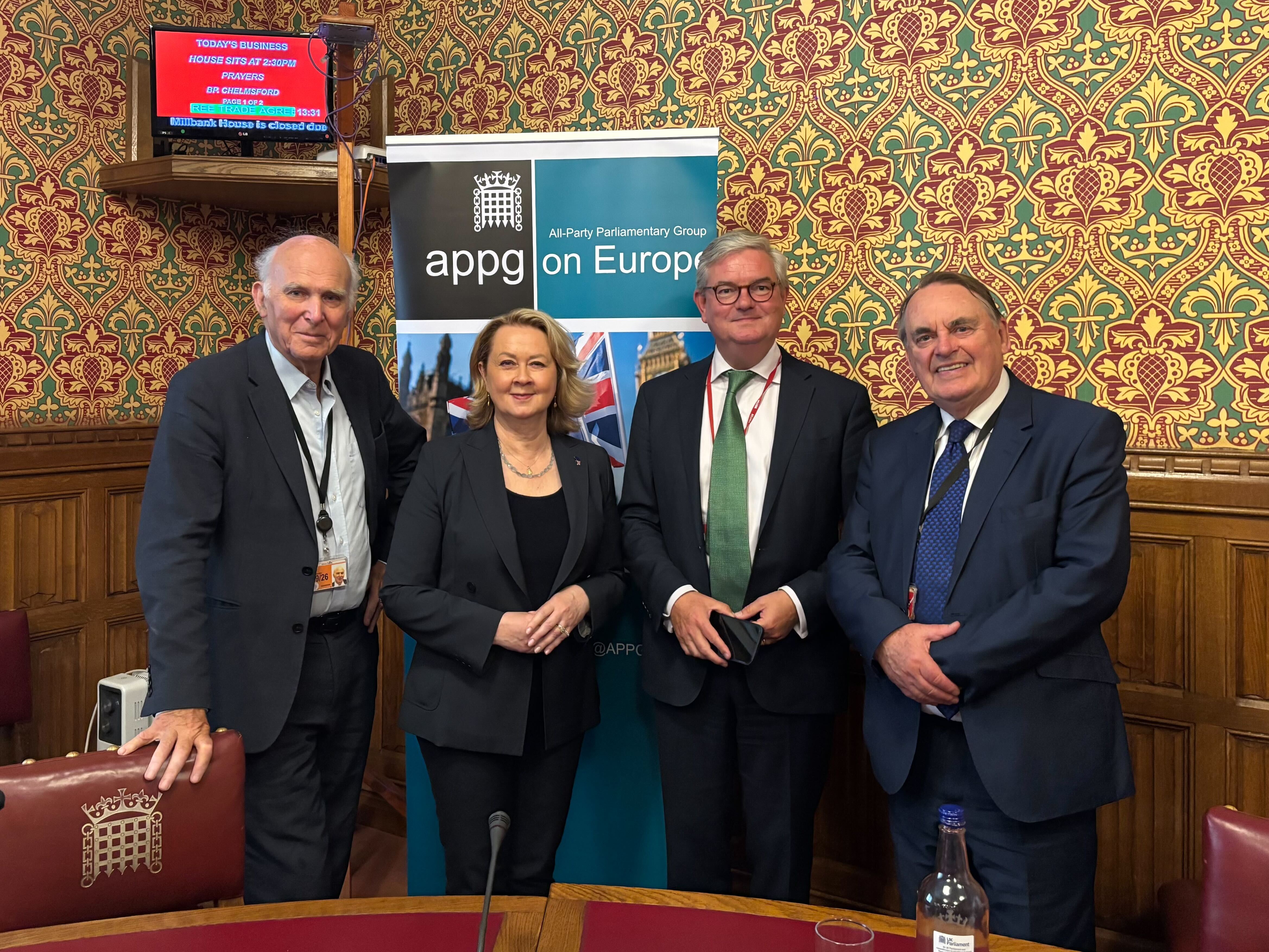
The meeting opened with reflections on the changed public and political mood since Brexit. There was broad recognition that the economic and political consequences of leaving the European Union are now more clearly understood, with polling and recent evidence suggesting growing public support for a closer relationship with Europe. Speakers noted that expectations around the UK–EU reset are high, though there remains uncertainty about how far and how quickly progress can be made.
Sir Julian King, former European Commissioner for the Security Union and former UK Ambassador to France, set out the rapidly changing defence and security context. He argued that the world has shifted dramatically over the past decade, with Europe now facing a much more challenging geopolitical environment and the United States becoming a less predictable security partner. Against that backdrop, he said it is essential that the UK finds effective ways to engage with the EU’s growing defence role.
Sir Julian welcomed the new UK–EU Security and Defence Partnership, but stressed that it should be seen as a starting point rather than an end in itself. He argued that the UK should be treated as a trusted partner, particularly on defence, intelligence and wider security. He also highlighted the need to revisit areas where Brexit had damaged practical cooperation, including the UK’s exclusion from Galileo and the loss of access to major European law enforcement databases.
He warned that leaving the Schengen Information System had created a serious gap in security cooperation, with a significant drop in the number of alerts shared between the UK and EU partners. This, he argued, is not only a UK problem but a shared European security problem, and one that should be addressed through renewed trust and practical cooperation.
Sir Vince Cable, speaking as Chair of Business with Europe, gave a strong business perspective on the UK–EU reset. He made clear that Business with Europe is a non-party political initiative, working across the political spectrum to ensure that business interests are heard in the debate about Britain’s future relationship with Europe.
Sir Vince said that the business community broadly welcomes the Government’s reset with the EU, but also feels that progress could go further and faster. He reflected on the discussions Business with Europe has held with business leaders, including recent roundtable engagement, and said that many firms continue to face practical and ongoing costs from Brexit. These are not simply historic grievances, but live operational problems affecting trade, investment, regulation and day-to-day business decisions.
A central theme of his remarks was the need for a better process. Sir Vince argued that business has often been consulted in a rushed, ad hoc or fragmented way, with no clear mechanism for feeding its concerns into negotiations. He said there should be a more structured and formal consultative process, allowing businesses of different sizes and sectors to engage directly with officials and those carrying the political mandate for negotiations.
He suggested that such a process could involve parliamentary structures, the APPG, the Parliamentary Partnership Assembly, or other formal channels, but stressed that the important point was consistency. Business needs to know that its concerns are being heard, recorded, followed up and reflected in the UK’s negotiating priorities. For Sir Vince, one of the clearest takeaways from the meeting was the need to create a disciplined, ongoing route for business input into the reset process.
Leena Linnus, Head of the European Parliament Liaison Office in the UK, spoke about the importance of rebuilding human and parliamentary connections between the UK and the EU. She said that one of the most important losses after Brexit had been the weakening of regular personal contact between parliamentarians, officials and institutions on both sides of the Channel.
She highlighted the role of the UK–EU Parliamentary Partnership Assembly, which brings together members of the UK Parliament and the European Parliament. While its formal role includes monitoring the Trade and Cooperation Agreement and making recommendations, she emphasised that its informal value is equally important. Trust, she argued, is built through human relationships, regular dialogue and the ability to speak openly across institutions.
The discussion that followed touched on the need for Parliament to play a stronger role in scrutinising the reset process, the challenge of identifying quick wins, and the political difficulty created by the possibility of a future government reversing progress. Contributors also raised the question of whether the UK should now be more open about the longer-term goal of EU membership, while recognising the political sensitivities involved.
The meeting closed with thanks to all three speakers and a recognition that the APPG on Europe has an important role to play in the months ahead. As the UK–EU reset develops, the APPG will continue to provide a forum for parliamentarians, business voices and European partners to examine the practical steps needed to rebuild trust, strengthen cooperation and shape a closer future relationship with Europe.