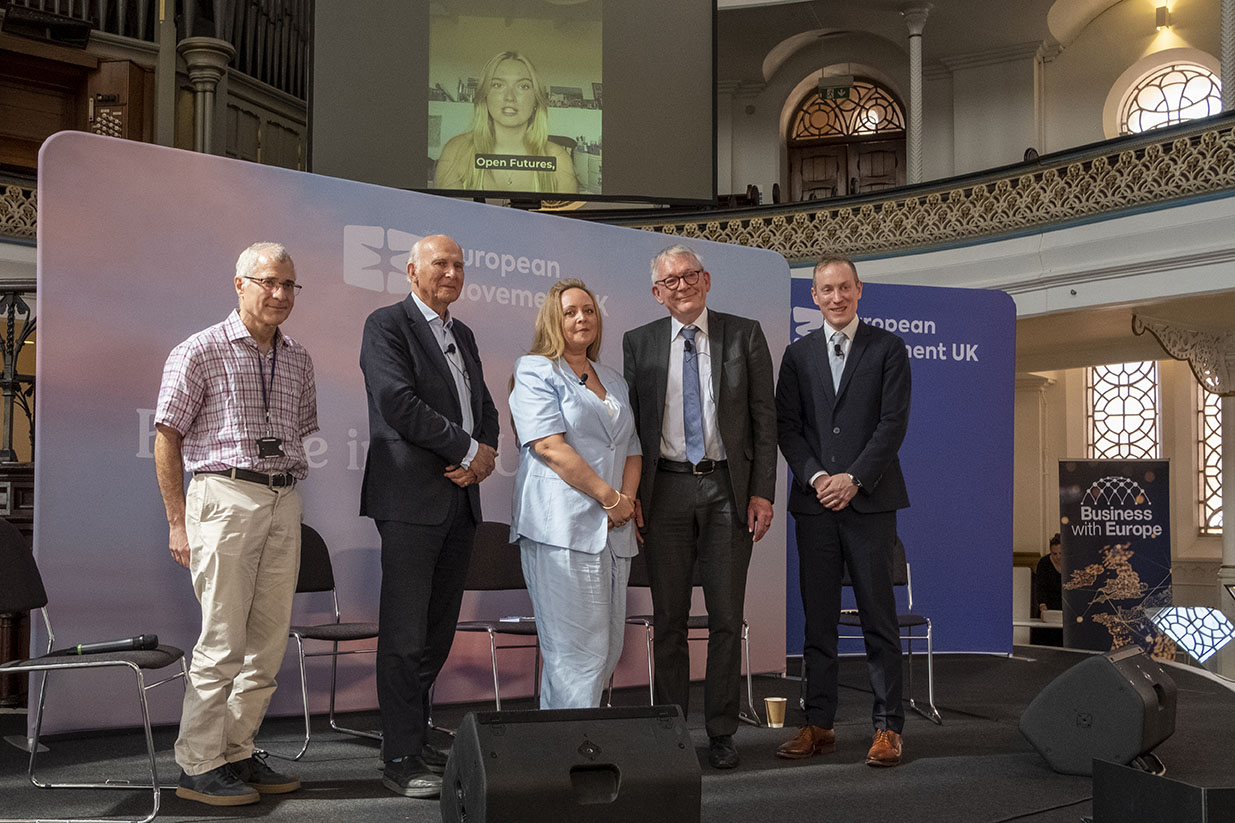
(From left to right: Professor Jonathan Portas - Kings College London, Sir Vince Cable - Chair of Business with Europe, Naomi Smith - CEO of Best for Britain, David Marsh CBE - Chairman of OMFIF, Owen Bennett - Fellow at Hertie School Centre for Digital Governance)
In the 'Freedom to Prosper' panel at European Movement UK's 'The UK's Future in Europe' event on 17 June, there was a wide-ranging discussion on the economic, trade and business case for working more closely with the EU.
The panel, chaired by Professor Jonathan Portas of Kings College London, heard contributions from David Marsh CBE, chairman of OMFIF, Naomi Smith, CEO of Best for Britain, Owen Bennett, fellow at Hertie School Centre for Digital Governance, and Business with Europe chair, Sir Vince Cable.
Here are some of the key insights:
The economic benefits of the current UK-EU 'reset' are relatively modest
Vince Cable pointed out that the improvements that have recently been negotiated amount to just a quarter of GDP, a small fraction of what was lost, and that 'cherry picking' with the EU will always be relatively expensive compared to bolder steps like joining the single market.
In addition to loss of GDP, being outside the EU has led to a 12-15% drop in investment
Naomi Smith outlined how elevated uncertainty, reduced demand, and management time spent on navigating new trading arrangements has impacted the economy across all measures.
Much of these losses can be clawed back - but cautious incremental steps probably won't be enough
Naomi weighed up pros and cons of various possible future arrangements with the EU, from joining the customs union, the single market, through to full membership, concluding that the biggest prizes will only come from the latter, because the chance to input into the EU's trade policy - to be rule-makers, not rule-takers - is crucial for creating economic opportunities and market confidence.
The EU is a moving target - its economies have changed since 2016. just as ours has
David Marsh looked across the channel to consider how countries such as Germany are faring, and how their relative economic performance is likely to influence attitudes towards UK negotiations to join the single market. David noted that we must be realistic about how many 'opt outs' we could expect to secure the next time round, but believes that on balance, the EU would look favourably on the UK's participation.
Closer integration with Europe offers huge opportunities for tech - but we must recognise that there will be trade-off
Owen Bennett drew on his background as a regulator at Ofcom to map out the new growth opportunities arising from tech and AI, and why being outside the EU leaves the UK less able to take advantage of these when global companies are looking to establish European headquarters. Closer integration would allow us to overcome this, and create other opportunities which would outweigh some of the accompanying limitations, for example some loss of regulatory autonomy.
SMEs could hugely benefit from closer EU integration, to avoid being subject to complex and costly country of origin rules
Owen explained that because digital services are inherently global nature, it would be a huge advantage to British SMEs to be able to offer their services across the EU without needing to comply with 27 separate sets of rules as they do currently.
In a world of superpowers, Britain has to choose between European cooperation and 'standing outside' - and potentially getting eaten alive
Vince outlined how the current global trade landscape, defined by conflict, and dominated by the USA, Russia and China, does not create conditions in which an isolated smaller country like the UK can easily compete and thrive, indicating a strong imperative for deep collaboration with the EU.
A big thank you to all the panellists for an informative and thought-provoking conversation.
Watch the full video here, and make sure you're signed up to Business with Europe's mailing list to hear about future events.